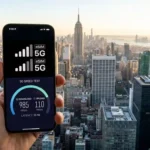
Manhattan is a concrete jungle of towering skyscrapers, deep subway systems, and massive crowds. For international tourists, finding the best mobile network in nyc is critical. Between thick concrete walls and millions of connected devices, network congestion can instantly kill your data speed if you choose the wrong carrier.
If you want to navigate Times Square, stream your walks, or hail an Uber on Wall Street without buffering, you need to understand how the major US networks operate. In this detailed guide, we break down T-Mobile, AT&T, and Verizon, and reveal exactly which travel eSIMs (Holafly, Airalo, and Nomad) use them and how they perform.
🔥 Provider Reviews: Read our full breakdown of Holafly and Airalo.
1. Detailed Breakdown of the US “Big Three” Networks in NYC
Before buying any digital SIM card, you must understand how the underlying local infrastructure works. Here is how the best mobile network in nyc landscape looks for visitors:
🔴 T-Mobile: The Speed King of the Streets
T-Mobile has invested heavily in Ultra Capacity 5G across New York City. If you are walking down Fifth Avenue, exploring Central Park, or standing in Times Square in the open air, T-Mobile usually delivers the fastest download speeds. However, because its mid-band frequencies can sometimes struggle to penetrate extremely thick historic brick and concrete buildings, you might notice a slight drop when walking deep indoors.
🔵 AT&T: The Best Indoor & Skyscraper Penetration
AT&T is historically famous for its reliable deep-indoor coverage. If you plan on visiting museums, shopping inside massive department stores, or touring historical buildings in Manhattan, AT&T’s signal holds up remarkably well against thick concrete blocks where other networks might flicker.
⚫ Verizon: Maximum Stability, High Congestion
Verizon has massive overall coverage across the entire state of New York. In terms of raw signal presence, it is everywhere. However, because millions of local New Yorkers use Verizon as their default carrier, tourist data streams can sometimes experience network congestion slowdowns during peak tourist hours in hyper-crowded spots.
2. How Travel eSIM Providers Connect to These Networks
As a tourist, you don’t need a local US contract. You can leverage these exact networks through digital eSIM providers. Here is how Holafly, Airalo, and Nomad utilize them:
🥇 Holafly: Dual-Network Access (AT&T & T-Mobile)
The Network Used: Holafly connects to both AT&T and T-Mobile depending on signal strength.
How it performs in NYC: This is the ultimate hack for Manhattan. If T-Mobile slows down inside a dense commercial block, Holafly’s infrastructure can switch your phone over to AT&T. Combined with unlimited data, it eliminates all network anxiety.
The Network Used: Airalo operates mainly on the T-Mobile network in New York.
How it performs in NYC: Excellent street-level 5G speeds. If you spend most of your time walking outside, taking photos, and using Google Maps outdoors, Airalo gives you snappy performance at a very low budget price point.
The Network Used: Nomad partners with tier-1 providers like AT&T and Verizon depending on the specific regional plan.
How it performs in NYC: Because Nomad leans heavily on AT&T/Verizon routes, it offers amazing indoor penetration and rock-solid stability in large public buildings, making it a stellar choice for structured data-bucket users.
Mohamed Kacha is a digital entrepreneur and tech writer specializing in international mobile connectivity and travel tech. With hands-on experience navigating roaming challenges and testing global eSIM solutions, Mohamed is dedicated to helping travelers stay connected seamlessly without breaking the bank