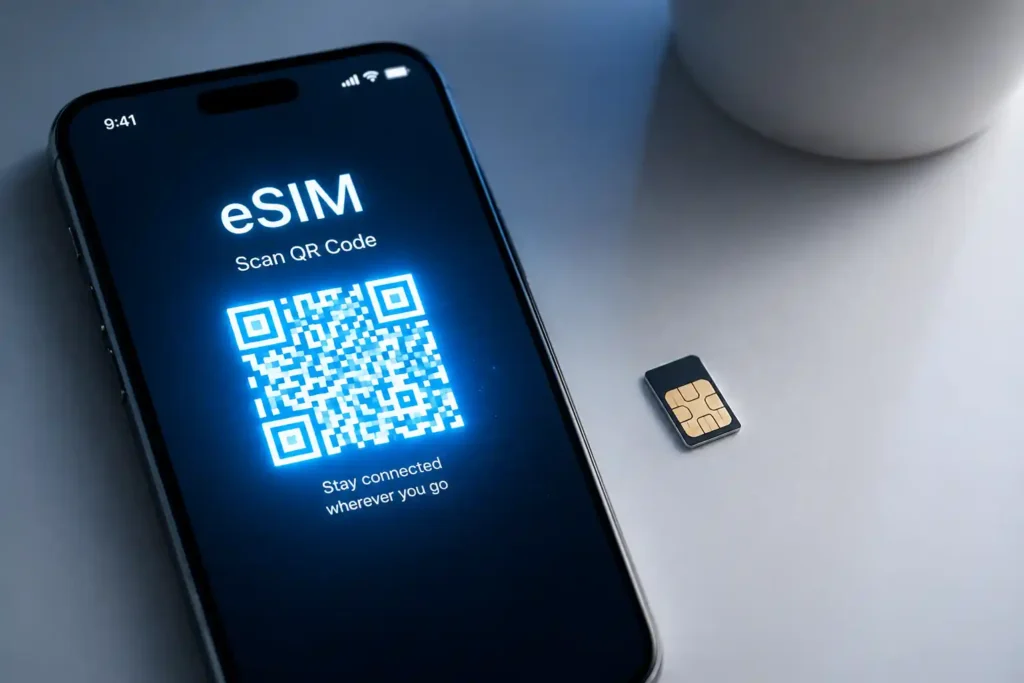
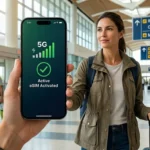
For over 25 years, the ubiquitous physical SIM card has played a fundamental role in mobile telecommunications. Naturally, we all know the drill: buying a plastic card, using a tiny ejector tool, and hoping we do not drop the microchip. However, the telecom industry is undergoing a massive shift thanks to esim technology.
Although the core role of authenticating your device onto a network remains the same, manufacturers have radically transformed the delivery method. In this guide, we break down exactly how digital SIMs work under the hood, how they compare to traditional plastic cards, and why this GSMA-backed standard represents the future of mobile data.
A standard Subscriber Identity Module (SIM) functions as a removable “Secure Element” storing your unique subscriber ID and network keys. Because it is a physical piece of hardware, users must manually transfer it between mobile devices.
While traditional SIMs remain reliable, they present clear limitations today. Specifically, they are susceptible to physical damage, require logistical shipping, and occupy valuable internal space inside modern smartphones.
2. What is an eSIM and How is it Built?
An eSIM (Embedded SIM) adopts the exact same security framework as a physical SIM but integrates it directly into the hardware. According to the GSMA, the eSIM standard allows operators to download network credentials securely into a permanent Secure Element soldered onto the motherboard.
🔑 Key Technical Characteristics
Remote Provisioning: Users can download profiles Over-The-Air (OTA) via Wi-Fi, thereby eliminating retail distribution.
Equivalent Security: The chip delivers the exact same cryptographic security as a physical SIM card.
Multiple Profiles: A single embedded chip stores multiple operator profiles simultaneously.
3. eSIM vs. Physical SIM: Head-to-Head Comparison
To clearly understand how esim technology outperforms legacy systems, let us examine a direct feature comparison:
Feature
Physical SIM Card
Embedded SIM (eSIM)
Delivery Method
Physical shipping or retail purchase
Instant digital download via QR code
Device Space
Requires a bulky SIM tray and internal slot
Microscopic chip soldered to motherboard
Profile Storage
1 network profile per physical card
Stores multiple network profiles digitally
Network Switching
Requires manually swapping out the card
Switch networks instantly via phone settings
4. Why the Industry is Making the Switch
Furthermore, the adoption of digital SIMs impacts the entire technology ecosystem, offering distinct advantages across sectors.
📱 Consumer Benefits
Travelers can easily switch operators remotely without roaming charges, thereby enjoying seamless Dual-SIM functionality.
🤖 IoT Connectivity
For IoT devices like smart cars and sensors, embedded chips save space and facilitate remote machine-to-machine connectivity.
🔒 Enhanced Security
Because thieves cannot physically remove the chip, users maintain better tracking capabilities if a device is lost.
Frequently Asked Questions (FAQ)
Is eSIM technology as secure as a physical SIM?
Yes. The GSMA designed embedded profiles to provide an equivalent level of cryptographic security to traditional cards.
Can I use a physical SIM and an eSIM at the same time?
Indeed, modern smartphones support Dual-SIM capability, allowing you to run both types simultaneously.
Will physical SIM cards become obsolete?
It is highly likely, especially since Apple already introduced eSIM-only iPhones in the United States.
Mohamed Kacha is a digital entrepreneur and tech writer specializing in international mobile connectivity and travel tech. With hands-on experience navigating roaming challenges and testing global eSIM solutions, Mohamed is dedicated to helping travelers stay connected seamlessly without breaking the bank