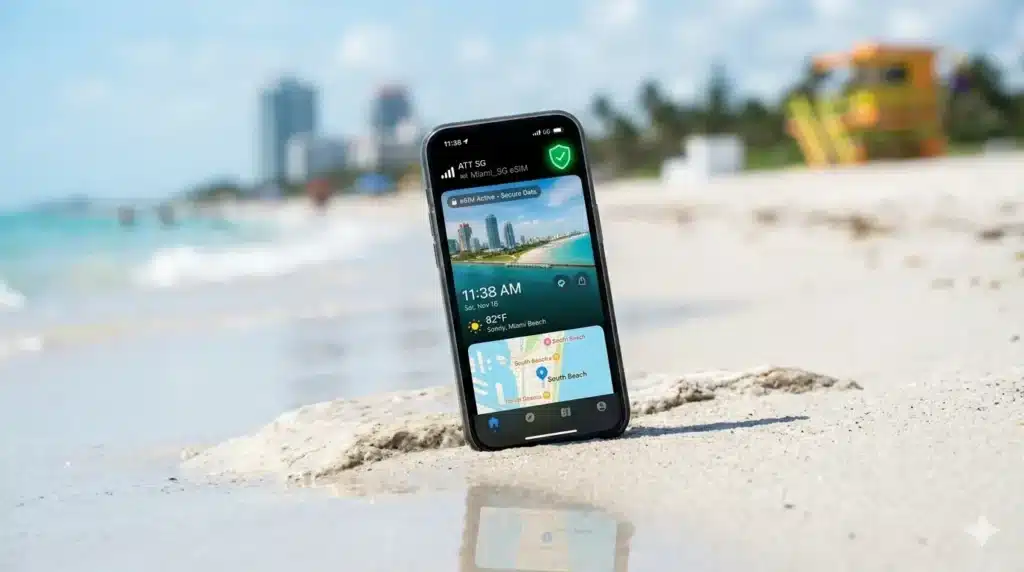
You are sitting at a trendy outdoor cafe on Ocean Drive, looking for a reliable South Beach Wi-Fi connection. Iconic Art Deco architecture and swaying palm trees surround you. The Miami sun feels warm, the music pulses, and you just ordered an iced coffee. To save your mobile data, you scroll through your phone’s network settings and click on a network named “Free_SouthBeach_Guest_WiFi.” Within seconds, the web page loads and you feel a sudden sense of relief. But behind that convenient, free connection lies a dangerous digital trap engineered by cybercriminals exploiting international tourists.
While you relax on the sand, a hacker might sit just two tables away, silently capturing every single byte of your private data. Relying on an unencrypted South Beach public Wi-Fi hotspot is one of the fastest ways to turn your dream Florida vacation into an identity theft nightmare. Fortunately, tech-savvy travelers completely bypass these coastal security threats by configuring a secure, private profile from a top Miami eSIM provider before stepping onto the sand.
🏙️ The Invisible Dangers of South Beach Public Wi-Fi
South Beach is a prime target for global cybercriminals because the area hosts millions of wealthy, distracted international tourists every year. When you log into an open network at a local beach club, hotel lobby, or public park, you enter a dangerous zone where traffic is broadcast openly into the local air.
🚨 The Hidden Cybersecurity Threats on Ocean Drive
The Twin Access Point Trap: Hackers deploy portable routers to broadcast fake network names mimicking local cafes.
Man-in-the-Middle (MITM) Interceptions: Malicious actors intercept your connection to record passwords and keylogs in real-time.
Packet Sniffing Exploits: Automated scripts scan open networks to extract active session cookies and credentials.
Malicious Pop-Up Injections: Corrupted public portals force background downloads of spyware under the guise of updates.
🛡️ Top Encrypted eSIM Solutions for South Beach
Do not gamble with your credit cards and passwords on unsecured beach networks. Bypass localized vulnerabilities with an encrypted, closed-loop data package:
Airalo routes traffic through secure US carrier tunnels, keeping your personal details invisible to local hackers on open networks. It is the perfect choice for budget-conscious travelers.
Pros: Highly affordable gigabyte bundles, easy to top up via the app, connects to premium local networks instantly.
Cons: Data is capped, meaning your connection will drop if you exhaust your purchased limit without reloading.
2. Holafly: Unlimited Protection for Peace of Mind
Holafly offers unthrottled unlimited data plans operating on top-tier encrypted channels. With Holafly, you never have to worry about data caps or turning on public Wi-Fi to save money.
Pros: True unlimited data, no overage anxiety, reliable encrypted premium network routing across Florida.
Cons: Premium unlimited plans carry a higher upfront cost compared to basic tiered data packages.
Nomad bridges the gap between budget and premium, allowing secure hotspot tethering to your laptop or tablet with encrypted app routing across the coast.
Pros: Flexible mid-tier data packages, robust user interface, and official support for mobile hotspot sharing.
Cons: Fixed data limits require careful monitoring if you plan to share your connection with multiple devices.
Activating a digital profile connects your device directly to major local towers (T-Mobile, AT&T, and Verizon) via authenticated cellular standards. T-Mobile dominates the South Beach geographic cluster with ultra-capacity mid-band 5G coverage right on the sand, while AT&T features robust micro-cells along Collins Avenue to penetrate thick hotel walls.
🛠️ Step-by-Step Security Protocol for Your Smartphone
Step 1: Disable Auto-Join Wi-Fi Settings
Turn off the option to automatically connect to open networks in your phone’s Wi-Fi settings. This prevents your device from silently linking to rogue routers.
Step 2: Activate Your Secured Travel Profile
Switch your mobile data line to your local digital profile before stepping onto Ocean Drive. Ensure data roaming is toggled on exclusively for that travel line.
Step 3: Verify Hardware Configuration
Ensure your phone is carrier-unlocked and compatible by checking our complete Miami eSIM Setup Handbook.
🏆 Secure Your South Beach Experience Today
Do not leave your data privacy, banking credentials, and peace of mind to chance on an open network. Before heading down to Ocean Drive, ensure your Miami Airport eSIM connection is active. Turn off public Wi-Fi, choose a verified high-speed plan, and enjoy safe 5G connectivity throughout South Beach! 🚀
Mohamed Kacha is a digital entrepreneur and tech writer specializing in international mobile connectivity and travel tech. With hands-on experience navigating roaming challenges and testing global eSIM solutions, Mohamed is dedicated to helping travelers stay connected seamlessly without breaking the bank